
The following is a guest post by Brad Coffey, an early employee at HubSpot. You can follow Brad on twitter @BradfordCoffey
This week HubSpot was lucky enough to be included in the Inc. 500 list of fastest growing private companies. It’s a great honor, we're really excited (and humbled) to be listed next to so many great companies. In an adjoinging article in Inc. Magazine, our CEO Brian Halligan discusses a key part of our success (and looks impressive in a full-page photo too). He talks about our approach to experimentation and our methodology for incubating new ideas. What Brian describes is three tiered approach to promoting and funding unconventional projects. It’s a methodology that served us well thus far and helped create an innovation pipeline that offsets our traditional disciplined focus on the core business.
The foundation of this framework is based heavily on Clay Christensen’s work in The Innovators Dilemma. We’re huge Clay Christensen fans at HubSpot (even have a conference room named after him) and have been life-long students of his work. In his work Clay asks a very straightforward question without an obvious solution - specifically: Why do well managed, successful companies repeatedly fail to create new disruptive innovations?
This framework was developed fundamentally to combat that challenge and create a lasting culture of entrepreneurial exploration.
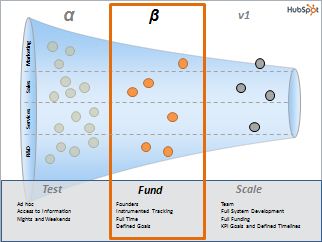
HubSpot’s Experimentation Framework
The framework has 3 stages, each with a distinct goal and approach.
Alpha – Lowering barriers to experimentation
No bureaucracy, no red tape, full access to information. This stage is simply focused on enabling anyone with energy and an idea to try a new solution. Tests are run by everyone and anyone – but are generally done in spare time (nights and weekends) and with few resources. You don’t need to ask permission to run these tests - and by design no one ever knows all the alpha stage experiments actively being pursued. It's open and distributed.
Beta - Determining proper funding
When an experiment reaches Beta stage the ‘founders’ are fired from their day job and work on the experiment full time. While founders determine their own goals and metrics – these leaders are encouraged to be patient for growth but impatient for profitable economics. Like many founders these people also report to a 'board' regularly and are subject to evaluation on future funding. At its core this stage is about providing access to funding for entreprenurial folks with new ideas and transparency/accountability into the success of those early tests.
v1 – Scaling successful experiments
v1 projects have proven economics and now are looking to scale the success. Often this requires growing the team beyond the founders, building dedicated systems and developing regular tracking of core metrics. Founders with experiments graduated to v1 are now considered 'mini-CEO’s' and are tasked with running their project as a start-up within HubSpot.
We established this framework in the hope of driving innovation and empowering the entrepreneurial edges of our organization to create change. It seems to be working - we’ve had several successful founders graduate from the program (Pete Caputa with VAR program, Jordyne Wu with the Services Marketplace) and we created a culture to be proud of. It's enabled us to focus on the core business without foregoing the entreprenurial engery and creativity of our team.
But is this enough? What do you think? Will this framework sustainably create the type of disruptive innovation required to create a lasting company? Any other ideas or tactics we might want to consider?